If you source metal core PCB product for LED lighting or power electronics, you’ve probably noticed most supplier listings read the same: “excellent thermal dissipation, ideal for LEDs.” What they never break down is how aluminum core, copper core, and mirror aluminum boards differ in real performance, which grade fits your application, and which options are overpriced overkill.
Below is a line-by-line analysis of three production-grade metal core PCB designs, evaluated from a hardware design and procurement perspective. We cover real-world use cases, critical technical tradeoffs, and the specific checks you should run before sending an inquiry — no generic “high quality” claims, just the details that impact thermal performance, light output, cost, and field reliability.
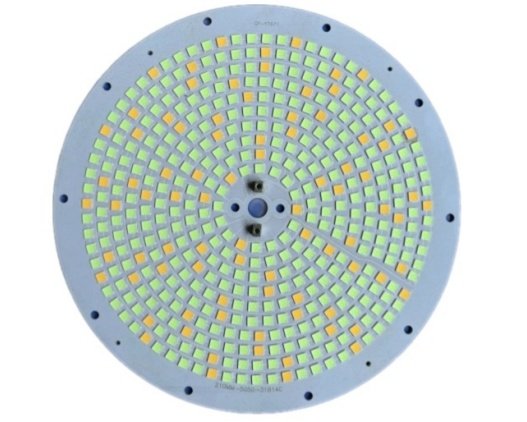
This large-format circular board is the volume workhorse of commercial and industrial LED lighting, built on a standard aluminum core substrate. The dense grid of SMD LED footprints is laid out for uniform light distribution, with a continuous underlying copper spreader to move heat evenly across the aluminum base plate. Multiple perimeter mounting holes and a central alignment feature simplify fast, repeatable installation into standard UFO high bay and flood light housings. High-reflectivity white solder mask is used as standard to maximize forward light output.
Typical end applications
Key technical characteristics
Procurement verification points: For high-power aluminum core LED boards, the biggest long-term risk is not raw thermal conductivity — it is dielectric adhesion and solder mask stability under sustained heat. Before placing an order, confirm the supplier uses an LED-formulated white mask; standard white solder mask will yellow and degrade reflectivity after 1–2 years of high-temperature operation. Also verify pad placement tolerance; even minor misalignment creates uneven thermal contact and localized hot spots that shorten LED lifespan.
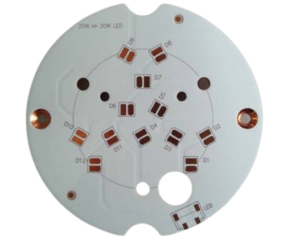
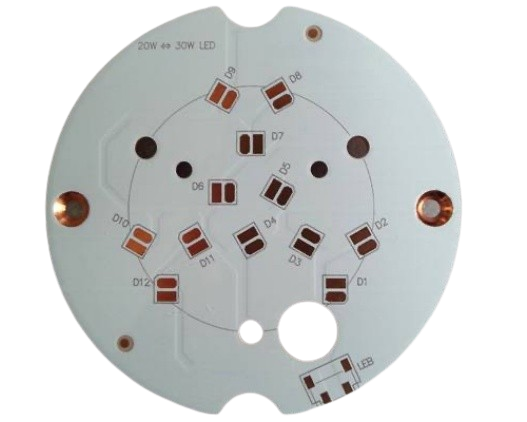
This compact round metal core PCB product uses a solid copper base instead of aluminum, delivering roughly 2.5x higher thermal conductivity for high-density COB and spotlight designs where board area is tightly constrained. Twelve LED/COB footprints are arranged in a ring to produce a uniform beam pattern, with notched edge features for precise positioning inside the fixture housing. The higher thermal performance of copper keeps junction temperatures lower at equivalent power levels, extending LED life and improving color stability.
Typical end applications
Key technical characteristics
Procurement verification points: A common and costly mistake is defaulting to copper core for every high-power design. Copper delivers superior thermal performance, but it costs 2–3x more than aluminum, is significantly heavier, and requires tighter process control for drilling and plating. For most 20–30W downlight designs, a good aluminum core board with proper thermal design will perform within 3–5°C of a copper core board at a fraction of the price. Copper core is justified only when board area is extremely limited, or when every degree of junction temperature reduction directly impacts product warranty or lifespan claims.
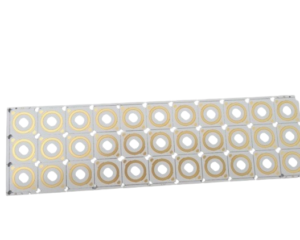
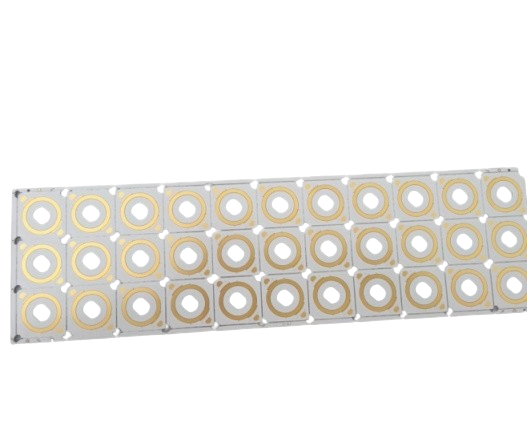
This panelized array of individual LED pads is built on a mirror finish aluminum substrate, optimized for maximum light extraction efficiency in linear lighting products. Each square pad sits on its own isolated thermal island, with V-cut score lines between units for clean depaneling. Unlike standard white solder mask boards, the reflective mirror surface redirects side-emitted light forward, increasing overall lumens per watt without higher drive current. The long strip format maximizes material utilization for run-of-meter products like wall washers and under-cabinet lighting.
Typical end applications
Key technical characteristics
Procurement verification points: Mirror aluminum PCB delivers measurable light output gains — typically 5–10% higher system efficacy vs. standard white mask aluminum boards — but it introduces handling and quality risks other MCPCBs do not. The reflective surface scratches easily, so proper protective film coverage during shipping and assembly is mandatory. Also confirm V-cut depth is tightly controlled; over-scoring can crack the reflective surface and dielectric layer at the score line, creating long-term reliability issues.
| Specification | Standard Available Options |
| Base Material | Aluminum 5052 / 6061, Copper C110, Mirror Finish Aluminum |
| Base Thickness | 0.8mm, 1.0mm, 1.5mm, 2.0mm, 3.0mm; custom available |
| Circuit Layers | 1 layer (standard); 2 layer/multilayer upon request |
| Copper Weight | 1oz, 2oz, 3oz, 4oz |
| Dielectric Thermal Conductivity | 1.0 W/mK, 1.5 W/mK, 2.0 W/mK, 3.0 W/mK |
| Surface Finish | Lead-free HASL, OSP, ENIG |
| Solder Mask / Surface | High-reflectivity white (standard), mirror aluminum, green, black |
| Outline Processes | Routing, V-cut (diamond tooling), punching |
| Tolerance Standard | IPC-A-600 Class 2 |
| Testing Services | Flying probe test, hi-pot test, peel strength test, reflectivity verification |
MCPCB is not a universal upgrade, and selecting the wrong base material wastes money with minimal performance gain. Use this framework to match the board to your requirements.
| Base Type | Thermal Performance | Relative Cost | Weight | Best Application Fit |
| Standard Aluminum Core | Good | Baseline | Light | General LED lighting, power supplies, most commercial designs |
| Copper Core | Excellent (≈2.5x aluminum) | 2–3x aluminum | Heaviest | Ultra-compact high-power COB, precision lighting, extreme power density |
| Mirror Finish Aluminum | Good thermal + optical gain | ~15–30% premium over standard aluminum | Light | Linear lighting, architectural fixtures, efficacy-critical designs |
When to skip MCPCB entirely: If your design runs below 5W total and has open airflow, a standard FR4 board with thermal vias will almost always be cheaper and perform adequately. MCPCB only delivers meaningful value when power density and enclosure sealing make FR4 thermal management insufficient.
Design rules for FR4 do not always transfer to MCPCB. Follow these guidelines to keep yield high and avoid field failures.
For volume LED programs, lock in base material and dielectric grade early in the design phase. Switching material grades after tooling is set requires requalification and adds lead time and cost.
Metal core PCB products are used primarily for high-power LED lighting, power supplies, motor drives, and other heat-intensive electronics where standard FR4 boards cannot dissipate enough heat. They are the industry standard substrate for commercial, industrial, and automotive LED lighting.
Copper core PCB has roughly 2.5 times the thermal conductivity of aluminum core PCB, delivering lower junction temperatures for equivalent power levels. However, copper core is 2–3 times more expensive, heavier, and more difficult to machine. Aluminum core is the most cost-effective choice for most general LED designs.
Mirror-finish aluminum PCB uses a highly reflective base surface to redirect side-emitted light forward, increasing overall system lumens per watt by 5–10% compared to standard white solder mask boards. It is widely used in architectural linear lighting, wall washers, and efficacy-critical LED fixtures.
For high-power or densely packed LED designs, yes. Aluminum core PCBs reduce LED junction temperatures by 10–20°C compared to equivalent FR4 boards with thermal vias, extending LED lifespan and maintaining consistent light output. For low-power indicator LEDs, FR4 is usually sufficient and more economical.
Yes. Panelized arrays with V-cut separation are standard for volume MCPCB production. Diamond tooling is required for clean scoring on aluminum and copper base material.
A standard single-layer aluminum MCPCB costs roughly 1.5 to 2.5 times more than an equivalent single-layer FR4 board, depending on base thickness and dielectric grade. Copper core and mirror aluminum designs carry a larger premium.
If you’re developing an LED lighting or power electronics design and need to validate MCPCB material selection, send us your Gerber files, power requirements, and target volume. Our engineering team will run a full MCPCB-specific DFM review, flag any thermal or manufacturability risks, and provide a transparent quotation with clear lead times.
We manufacture standard aluminum core, copper core, and mirror-finish aluminum PCBs for lighting, industrial, and automotive applications, with full compliance documentation for overseas markets. Contact us today to get started.
UpSmart PCBA brings nearly a decade of expertise to multilayer PCB manufacturing, serving industrial clients worldwide that demand tight tolerances, long-term durability, and batch-to-batch consistency.
We focus on custom PCB fabrication and full turnkey PCBA assembly. Your design files move straight through production into fully built, tested units ready for final installation — no fragmented handoffs between separate vendors. We scale seamlessly from small prototype runs to high-volume mass production, with end-to-end in-house capabilities spanning component sourcing, bare board manufacturing, in-process quality testing, and final packaging.
We build every order around three non-negotiables: quality, engineering rigor, and reliable turnaround. For our global industrial customers, this translates to simpler supply chains, fewer production disruptions, and electronic systems that deliver consistent performance over their full service life.
Email: sales@upsmartpcba.com
WhatsApp/Phone: +86 199 2656 6516