
UpSmart PCBA supports OEM & EMS, Box Build Product, personal PCR thermocycler box build, benchtop lab device system integration, medical education device box build assembly, compact PCR machine full turnkey assembly, box build system integration for lab equipment, temperature cycling device box build service, turnkey box build for scientific instruments, IPC Class 2 box build manufacturing, custom enclosure integration for lab electronics, complete system assembly for portable PCR device
If you’ve ever brought a laboratory benchtop instrument to market, you already know the hard truth: a box-build product is far more than a PCBA dropped into an off-the-shelf enclosure. For temperature-critical devices like personal PCR thermocyclers, even a 0.8°C well-to-well temperature variation, a misaligned sample block, or a poorly tuned thermal control loop will turn a perfectly good board-level design into a unit that fails assay consistency, returns at twice the expected rate, and erodes end-user trust.
This deep dive breaks down a production-ready personal PCR system from a manufacturing engineering and procurement perspective. Built as a complete turnkey instrument with integrated thermal cycling, user interface, and sample handling, this box build is designed for educational labs, small research teams, and low-throughput testing environments. We’ll cover system architecture, integration tradeoffs that directly impact assay performance, volume manufacturing quality gates, grade selection, and how to vet an EMS partner that delivers consistent, calibrated, field-ready instruments — not just “parts bolted into a box.” No generic marketing claims — just the technical and operational details that determine your field reliability, calibration consistency, and total program cost.
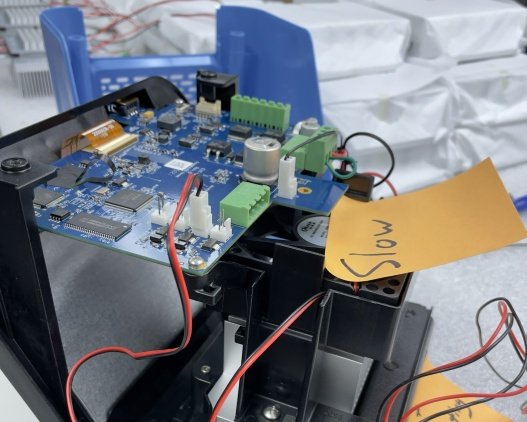
This complete instrument is a compact benchtop thermal cycler, purpose-built for nucleic acid amplification workflows in small-format lab settings. The design integrates four core subsystems into a single enclosure: thermal sample block, control electronics, user interface, and power delivery.
| Category | Specification | Design Rationale |
| Thermal Core | Peltier-driven aluminum sample block | Fast ramp rate for short cycle times |
| Temperature Range | 14 °C to 99 °C | Covers standard denaturation, annealing, and extension temperatures for PCR |
| Well-to-Well Uniformity | ± 0.5 °C across block | Calibrated per unit for consistent amplification across all sample wells |
| Ramp Rate | 22.25 °C/sec typical | Balances speed and thermal uniformity for reliable assay results |
| User Interface | Color touchscreen display with on-device programming | Standalone operation without external PC; intuitive workflow navigation |
| Connectivity | USB data transfer + optional PC control | Supports protocol upload, run logging, and result export |
| Power Input | 110 V AC, universal input | Global mains compatibility for educational and research markets |
| Enclosure Construction | Flame-retardant ABS housing with integrated cooling | Compact benchtop footprint; passive + active thermal management |
| Workmanship Standard | IPC-A-610 Class 2 on internal PCBA | Built to commercial scientific instrument acceptability criteria |
| Calibration | Per-unit temperature calibration with traceable reference | Each unit ships with calibration certificate |
The split architecture — dedicated thermal hardware + separate control PCBA + user interface subassembly — is a defining choice for personal PCR thermocycler box build systems. It isolates high-power thermal switching from sensitive measurement circuits, improving temperature stability and reducing measurement noise that would otherwise degrade reaction consistency.
Four integration challenges routinely sink low-cost box-build system integration for lab equipment programs. Each is invisible on a component-level BOM, and each directly determines real-world instrument performance.
The single biggest driver of PCR performance is temperature accuracy across the sample block. In this design, the thermal block is mated to the Peltier stack with controlled thermal interface material thickness and uniform clamping pressure. Every production unit is calibrated against a traceable reference probe across the full temperature range, with correction coefficients stored in on-board memory.
Lower-tier box build shops skip per-unit calibration and rely solely on nominal component values. The result is well-to-well variation that exceeds 1.5°C — enough to cause failed reactions and inconsistent results. For temperature cycling device box build service programs, per-unit thermal calibration is not a nice-to-have; it is the core deliverable.
The sample block, internal PCB, display window, and enclosure all have independent manufacturing tolerances. If no one accounts for the total stackup, the block will sit misaligned to the lid, the display will be offset in the bezel, or the unit will have uneven fit and finish. This design uses controlled reference datums across all subassemblies, with DFM reviews that evaluate all parts together — not each part in isolation. This is the most commonly skipped step in commodity benchtop lab device system integration, and the most common cause of cosmetic and fit quality issues in volume.
Lab instruments are operated by end users with varying technical skill levels. This design includes fully insulated high-voltage sections, fuse-protected input power, and a sealed user interface resistant to spills and cleaning agents. Service access points are designed for tool-free maintenance, with clearly marked user-replaceable parts. For turnkey box builds for scientific instruments, usability and safety are not afterthoughts — they are designed in from the start.
The enclosure is designed for disassembly, with modular subassemblies that can be replaced individually in the field. This reduces service cost and extends instrument life, which is a major value driver for education and research customers. Many cheap box builds are glued or permanently fastened, making even a simple fan replacement a full teardown job.
Delivering consistent complete system assembly for portable PCR device products at volume requires defined, auditable process gates across every integration stage. A mature box build flow includes these mandatory steps:
For custom enclosure integration for lab electronics programs, per-unit thermal calibration is the step that most inexperienced EMS partners skip — and the step that catches 80% of field performance issues before units leave the factory.
Not every PCR instrument program requires the same performance and certification level. Choosing the right grade is one of the highest cost and risk decisions a procurement team makes.
| Grade | Typical Application | Temperature Accuracy | Required Compliance | Relative Cost | Typical Annual Field Failure Rate |
| Educational | Classroom teaching, student lab kits | ±1.0°C typical | RoHS / basic safety | 1.0x baseline | 4 – 6% |
| Research / Benchtop | University labs, small research groups | ±0.5°C typical | RoHS / IEC 61010-1 lab safety | 1.8 – 2.3x | 1 – 2% |
| In-Vitro Diagnostic | Clinical/diagnostic use | ±0.3°C or better | FDA / IVDD, ISO 13485 manufacturing | 4.0 – 6.0x | < 0.5% |
Most education and entry-level research programs fall into the educational / research grade. Full diagnostic grade is only justified for clinical testing applications with regulatory submission requirements.
A box build product is a fully integrated, ready-to-use electronic system that includes PCBA, mechanical enclosure, wiring, user interface, and packaging — not just a bare printed circuit board assembly. Box build delivers a finished unit that can be shipped directly to an end user.
PCBA-only service covers only the soldered circuit board. Full box build includes integration of the board into an enclosure, wiring harness installation, mechanical assembly, system-level testing, calibration, and final packaging.
For any instrument used for real experimental work, yes. Normal component and assembly variation creates enough performance spread that uncalibrated units will have widely different thermal accuracy. Per-unit calibration with a traceable reference is the only way to guarantee consistent results across a production lot.
Technically, yes, but results vary dramatically. Box build requires mechanical integration expertise, system-level test infrastructure, and calibration capability that most board-only assembly shops do not maintain as standard practice.
Poor thermal assembly and skipped calibration are the number one performance failure causes. Mechanical tolerance and fit issues are the second most common. Both are largely preventable with proper up-front DFM review and controlled integration processes.
If you’re developing a PCR instrument, lab device, or other benchtop product and need a manufacturing partner with real box build and calibration experience, send us your design files, BOM, and target volume. Our engineering team will provide a complimentary DFM review, risk assessment, and transparent quotation with clearly separated NRE and per-unit costs.
We specialize in complete box-build product programs for scientific, educational, and industrial instruments, with controlled integration processes, in-house calibration, and full quality traceability. Contact us today to discuss your program.
UpSmart PCBA brings nearly a decade of expertise to multilayer PCB manufacturing, serving industrial clients worldwide that demand tight tolerances, long-term durability, and batch-to-batch consistency.
We focus on custom PCB fabrication and full turnkey PCBA assembly. Your design files move straight through production into fully built, tested units ready for final installation — no fragmented handoffs between separate vendors. We scale seamlessly from small prototype runs to high-volume mass production, with end-to-end in-house capabilities spanning component sourcing, bare board manufacturing, in-process quality testing, and final packaging.
We build every order around three non-negotiables: quality, engineering rigor, and reliable turnaround. For our global industrial customers, this translates to simpler supply chains, fewer production disruptions, and electronic systems that deliver consistent performance over their full service life.
Email: sales@upsmartpcba.com
WhatsApp/Phone: +86 199 2656 6516
specializing in end-to-end printed circuit board fabrication and full-turnkey PCB assembly services.